Agents Need Boundaries
Trust (in AI agents) must be engineered, not implied. This is what we refer to as "Agent Physics".
We spent the last few days staring at the car crash. And rightly so. Openclaw was a security nightmare, a credential sieve, and a live demo of what happens when you let code execute other code based on "vibes" and bad engineering practices.
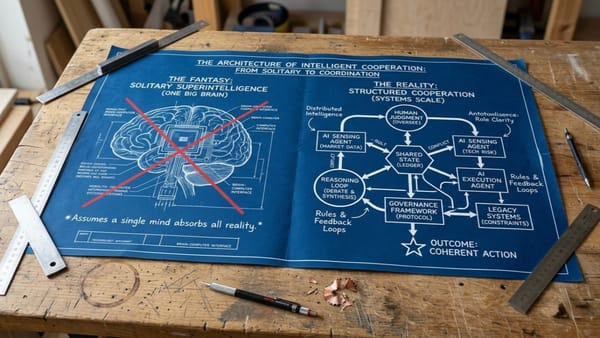
The State of Agents (Part 3/6) shifts the focus from what agents do (Skills/Agency) to how we govern them. We believe the current trend of "AI Supervisors" doesn't make sense, and explain why we think "Physics for Agents" is the superior safety model.
OpenClaw isn’t evil. It’s just what happens when you take a hungry piece of software, give it the keys to your life, and then act surprised when it tries the doors.
The risk is not rogue agents. It is human drift in the presence of fluent authority. Build flows that force choice, preserve values, and keep the human in control.
The State of Agents (Part 2/6): Why "Self Empowerment" is a consumer fantasy, and true agency requires authority to act.
You wouldn't hand a new intern the keys to your office, without explicit intent, boundaries and controls. Why do it with AI?
Precise language prevents sloppy engineering. We project agency onto fluent bots, creating a security risk. Real intelligence requires stakes - a loop with reality LLMs lack. Solve this with architecture: explicit intent and proof.
Traditional onboarding fails at the last mile. It treats data as a passive record rather than a signed state change. Learn how Supamoto uses IXO components to enforce integrity on the edge.