The purpose of a system is what it does
What happens when systems become "AI-enabled" to move faster, increase coordination, and do more?

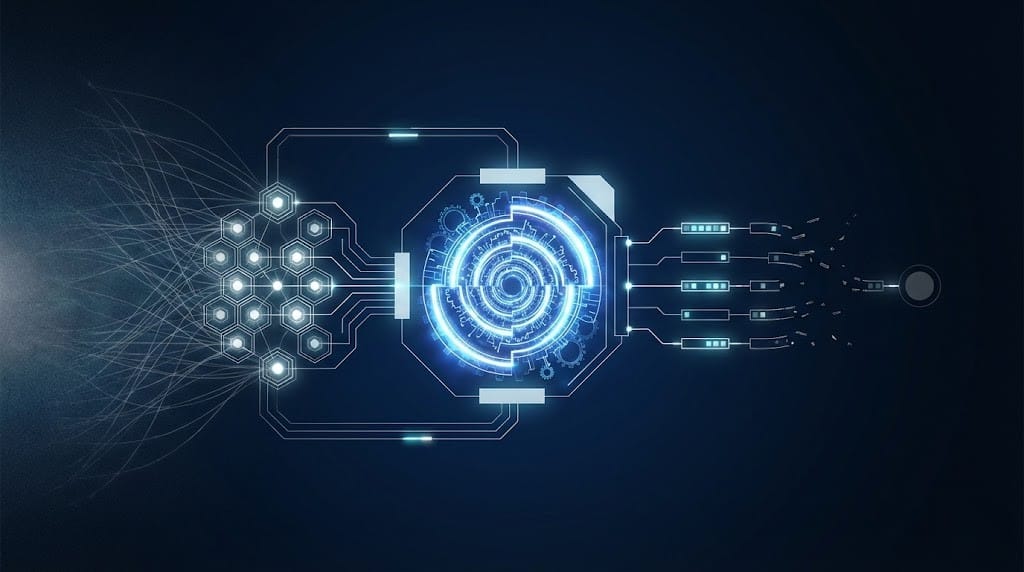
Stafford Beer, one of the fathers of cybernetics, had a brutal heuristic for understanding the world: “The purpose of a system is what it does” (POSIWID).
Forget the glossy mission statements. Forget the designers' good intentions. You infer a system’s real purpose from its actual, recurring outcomes. If a system consistently produces polarisation, its purpose is polarisation. If it continually degrades the environment, its purpose is degradation.

Right now, the tech world is obsessed with building massive, disembodied intelligence—more compute, bigger models, sharper predictions. But intelligence in a vacuum is useless. If you have the brain of a genius but your spinal cord is severed, you’re paralysed.
Look at our globalised civilisation. We have built a body with incredible eyes but zero reflexes. We can watch a wildfire from space in high-definition, yet our institutional response arrives days late. We track global supply chains to the microsecond, but we can’t coordinate a simple shift in behavior when a planetary boundary is crossed.
We are rich in instruments and completely bankrupt in coherence.
Fiduciary Intelligence: The Missing Layer
We don't need more clever automations wrapped in legal disclaimers. We need AI agents that operate as instruments of a fiduciary relationship. This means building systems explicitly designed for loyalty, care, conflict-handling, and auditable responsibility.
This requires a massive shift in how we architect technology. We have to stop treating intelligence solely as a "brain." Living bodies don’t survive just by being smart. They survive by maintaining a high-fidelity, symbiotic relationship with reality.
I’m not being poetic when I say we are building Qi to function as a nervous system, and IXO to act as a digital immune system. I am describing the literal, necessary physiology for a civilization that intends to survive.
We already have the raw materials. We have satellites, IoT networks, and global markets acting as sensory organs. We have algorithmic trading and automated alerts acting as reflex arcs. But we have no coherence. We have organs without a shared body.
- Qi is the missing integration: The circuitry that connects sensing directly to interpretation and response.
- IXO is the essential counterweight: Any nervous system that coordinates action at speed will amplify whatever is inside it. Without an immune response—a mechanism to detect anomalies, contain harm, and remember past injuries—increased coordination just means we’ll crash into the wall faster.
A planetary nervous system without an immune system isn't wisdom. It’s just power without protection.
 Dr Shaun Conway
Read about "Fiduciary intelligence", the discipline of building AI agents that operate as instruments of a fiduciary relationship—loyalty, care, conflict-handling, and auditable responsibility—rather than as clever automations wrapped in disclaimers.
The Three Pathologies of the Present
Look at climate action, global governance, or finance. You will see the same three failure modes repeating. These aren't data failures; they are physiological breakdowns:
- Numbness: We have so much data that our attention is anesthetized. We casually scroll past warnings about planetary collapse. A numb system doesn't need more sensors; it needs aggressive prioritization and the authority to act on weak signals before they become screams.
- Seizure: The system overreacts to the wrong inputs. Our reflexes are hijacked by bad incentives, sending us into spasms over short-term market fluctuations or algorithmic outrage.
- Neuropathy: The signals exist, but the "nerves" are damaged. Crucial data never reaches the frontline people who can actually fix the problem, or it arrives stripped of all usable context. This is a governance failure masquerading as a technical one.
Qi cures the neuropathy by building loops that actually land where response is possible. IXO prevents the seizure by enforcing constraints that interrupt runaway amplification.
Building Cybernetic Loops, Not Platforms
To fix this, we have to stop building static "platforms" and start building dynamic cybernetic loops.
- The Sensing Loop (Relationship): This isn't just about scraping data points. If sensing is extractive—taking data from an ecosystem or a community without giving back—the nervous system becomes parasitic. The first design question must always be: What does this system owe back to the people and places it measures?
- The Coordination Loop (Timing): This is about rhythm, not just velocity. A healthy reflex acts early enough to change an outcome, but gently enough not to break the system. This requires distributed decision rights—giving the "edge" the actual authority to act.
- The Integrity Loop (Memory): This is where IXO lives. It’s the stack of provenance, verification, and memory. It’s the immune system saying, "We’ve seen this type of pathogen before; here is the antibody protocol to shut it down."
The Trade-off We Can't Ignore
Here is the uncomfortable reality, bringing us right back to POSIWID: We are building systems that are becoming exponentially more effective at whatever they were already doing.
If our incentives remain extractive, an intelligence-driven operating system like Qi will simply become a high-speed engine for extraction. If our culture remains addicted to conflict, we are just building a precision instrument for warfare.
This is why IXO is fundamentally built on identity protocols. A biological immune system must know the difference between "self" and "not-self" to function. At a planetary scale, we have to decide who "us" is. What are the sacred constraints we absolutely refuse to trade away for a short-term gain?
If we don't define those boundaries now, the system will optimize us right into oblivion.
From Awareness to Embodied Response
Awareness is not the endpoint.
In a biological body, practice turns deliberation into competence. You don't "think" about how to catch a falling glass; your nervous system has encoded the response. Our goal is to move civilisation from "knowing" to "doing." We need playbooks that operationalise thresholds and protocols that eliminate friction under stress. Without that motor-learning layer, we remain brilliant in theory and clumsy in reality.
The next stage of human progress isn't a higher collective IQ. It’s a mature physiology—the ability to coordinate at scale without destroying the living systems we depend on.
We are already building a planetary nervous system; that is no longer a question. The only question left is whether we have the maturity to give it an immune system before it's too late.
Two questions to ground this in your own reality:
- If your organisation’s ability to coordinate increased by 10x tomorrow, which of your current incentives would become the most dangerous?
- What is a "weak signal" in your operation right now that you are currently too numb to act on?