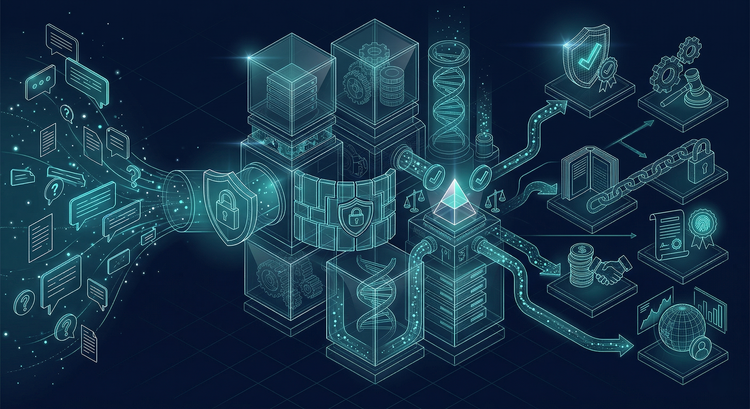
We are currently witnessing a massive shift in the AI landscape. We are moving from the era of "Chat"—where the output is text—to the era of "Agency"—where the output is action.
However, the leap from a chatbot to an autonomous agent that touches enterprise data is perilous. It requires an architectural rethink. The recent 2026 trends analysis from Cloudera highlights a critical reality: to move AI into production, we must stop treating data as passive storage and start treating it as active intelligence.
 More by this author ›
This is the exact thesis behind Qi.
As we build a flow engine for human–AI cooperation, the Cloudera insights validate that the bottleneck isn't the model intelligence; it is the state in which that intelligence operates. Here is how we interpret the road ahead.
From Passive Storage to "Active Intelligence"
The days of dumping data into a lake and hoping an LLM makes sense of it are ending. The industry is realising that data requires embedded semantics, governance, and lineage before an agent touches it.
For Qi, this confirms that Shared State is the most valuable asset in the stack.
- The Shift: We are moving away from simple storage toward data as an intelligence layer.
- The Qi Approach: We treat datasets not as static files, but as live knowledge graphs. By embedding traceability and schema directly into the state, we allow agents to reason with context. When an agent acts in Qi, it isn't just guessing; it is navigating a semantic map that defines what the data means, not just where it sits.
Governance is the License to Operate
Enterprises will not let autonomous agents roam free without guardrails. The trend is clear: adoption hinges on multi-layered permissions, observability, and audit logs.
This is why Qi is designed with a Governance First mentality. We cannot bolt security on later; it must be baked into the flow engine.
- The Mechanism: Qi uses shared state as the single source of truth for both intent and outcome.
- The Result: By integrating scoped access controls and immutable action logs, we create a system where every state mutation is checked against policy guards. If the agent cannot prove it is allowed to change the state, the transaction fails. This ensures accountability is programmatic, not theoretical.
Eliminating Friction: Unified Control Planes
The modern infrastructure is messy—hybrid clouds, edge devices, and on-premise servers. The Cloudera trends emphasise that fragmented access limits productivity. We need a unified control plane.
For Qi, this dictates a distributed deployment strategy:
- Coherent State: Whether an agent is running on a localised edge device or a centralized cloud cluster, the state of the world must remain consistent.
- Synchronisation: Qi utilises realtime sync protocols and consensus strategies to bridge these environments. This allows us to abstract the complexity of the infrastructure away from the agent, letting it focus on the workflow rather than the plumbing.
Agents in the Workflow (Not Just the Chat Window)
AI is moving from experimentation to integration in core operational workflows. The goal is seamless bridging between human and AI operations.
This is the heartbeat of Qi. We believe in Human-AI Cooperation, not replacement.
- The Pattern: We prioritise patterns where human intentions and AI actions cohere via event streams.
- The Flow: Agents shouldn't just be triggered by a prompt; they should be triggered by the state of the real-world system. When the shared state changes (e.g., a ticket is logged, a discrepancy is found), the agent reacts. This embeds the AI directly into the operational flow alongside its human counterparts.
 Dr Shaun Conway
Observability: The "Why" Matters More Than the "What"
As agency increases, so does the need for trust. We need to know why an agent made a decision.
In Qi, observability is not a dashboard we look at once a month; it is part of the execution fabric.
- Causal Traces: We are building logs and causal trace graphs of state transitions.
- Explainability: Every decision record is stored. This allows for post-hoc review and debugging without disrupting live operations. If an agent takes a wrong turn, we can rewind the shared state to understand the logic gap.
The Verdict
The 2026 outlook makes one thing clear:
The winner in the next phase of AI won't be the one with the biggest model, but the one with the best context.
By building Qi around the concept of a governed, active, and shared state, we are not just following these trends—we are building the engine that makes them possible. The future of AI is collaborative, and collaboration requires a shared reality.

Qi is for:
- Anyone building or funding something that involves people and AI working together
- Founders use it to plan and prove progress
- Investors use it to track outcomes with evidence.
- Developers use it to orchestrate agent workflows that are verifiable and secure.