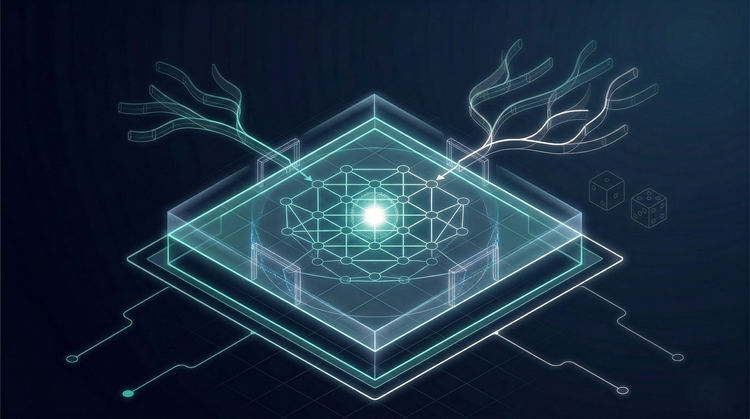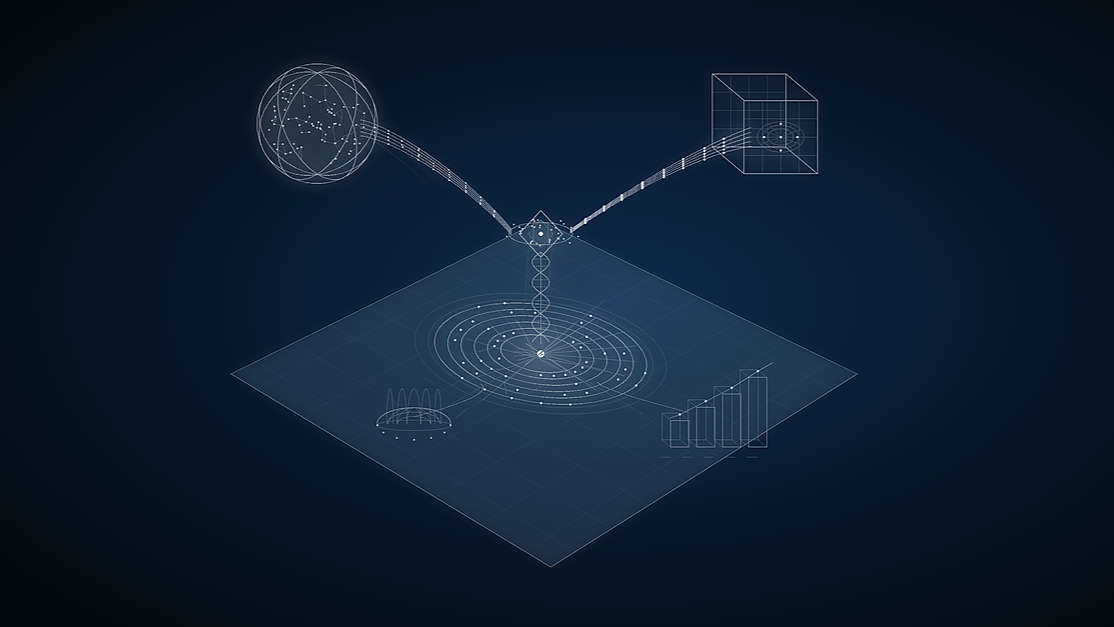
Jensen Huang has given us a compelling vision of the "AI token factory." Now the big guys are building vast industrial complexes dedicated to the production of intelligence, pouring hundreds of billions of dollars into this new infrastructure. These factories ingest data and compute, and they output tokens—fragments of language, code, imagery, and insight.
This is a breathtaking development. The marginal cost of generating intelligence is collapsing toward zero.
But as we start deploying autonomous agents into the real economy—tasking them with managing supply chains, disbursing climate finance, or navigating healthcare logistics, we are colliding with a fundamental architectural void.
Producing intelligence (tokens) is only half of the equation required for a functional machine economy.
If the generative AI boom represents the Yin—fluid, creative, probabilistic, abundant, and inherently chaotic, then the emerging machine economy is perilously short on Yang—the structural, restrictive, deterministic, and ordering force necessary to harness that chaos.
Intelligence is the ability to conceive of an action. Authority is the verifiable right to execute it. We have built the factories for the former. We must now build the factories for the latter.
We need Trust Token Factories.
Probabilistic vs. Deterministic
The fundamental friction is the interface between probabilistic AI models and deterministic societal systems.
A generative agent operates in probabilities. When asked to perform a multi-step workflow—such as verifying a carbon credit and issuing a payment—the agent predicts the most likely sequence of next tokens. It is a brilliant guesser.
However, banking systems, legal frameworks, and supply chain audits are not probabilistic. They are deterministic. A payment is either authorised or it is not. A compliance check either passed or it failed. There is no "hallucination" allowed in a SWIFT transaction.
Today, we attempt to bridge this gap with archaic infrastructure: centralised API keys and Access Control Lists (ACLs). We hand an autonomous, probabilistic agent a static "God Key" to a deterministic system and hope it doesn't go rogue. This is unsustainable. It is an attempt to impose order by granting limitless permission, which is the antithesis of security.
To balance the Yin of generative intelligence, we need an equally powerful Yang: an architecture of verifiable, highly attenuated execution.
The Anatomy of a Trust Token
If an Intelligence Token is a unit of potential thought, a Trust Token is a unit of verifiable kinetic energy.
Unlike an API key, which is a passive permission slip sitting in a distant server, a Trust Token, which is minted using emerging standards like User-Controlled Authorisation Networks (UCANs), delegates an active, mathematically proved capability to the executing agent.
It is the Yang force because it is defined by its constraints. A Trust Token Factory does not generate open-ended possibilities; it generates mathematically enforceable boundaries.
When an agent needs to act, it is not granted general access. It is issued a cryptographically signed token that states, with mathematical certainty: “This specific agent possesses the authority to execute exactly this function, on exactly this resource, under exactly these conditions, and this authority expires in exactly this many seconds.”
This shifts the fundamental model of the internet from "trust, then verify" to "verify, then trust." The executor of the task—whether it is a smart contract or a legacy database—does not need to check a centralised permission list. The token itself contains the irrefutable proof of its own authority.
Cryptographic Causality: The Ordering Principle
The chaotic potential of the Yin requires more than just constrained permissions at a single point in time. It requires temporal order across complex workflows.
In the human world, causality is maintained by institutions and audit trails. In the machine world, causality must be cryptographic.
If an autonomous workflow requires Step A (e.g., validate sensor data) before Step B (e.g., disburse funds), we cannot rely on a probabilistic agent to merely promise it did Step A. The agent must prove it.
This requires an architecture where every executed action generates a cryptographic receipt, with a deterministic hash, proving the exact output of that step. To execute Step B, the agent must present a new Trust Token that mathematically embeds the receipt of Step A within its causal chain.
This creates an unbreakable, Directed Acyclic Graph (DAG) of execution. It is the rigid structural steel that allows the fluid concrete of AI intelligence to be poured safely into towering complex systems without collapsing under its own weight.
Bringing Coherence to Intelligence
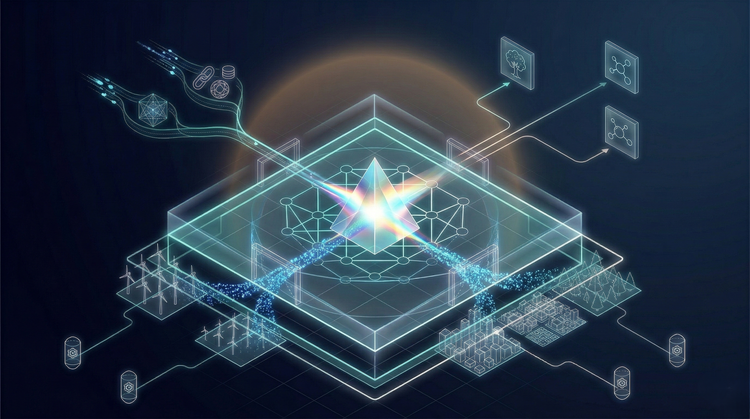
At IXO we are focused on architecting this missing half of the machine economy by building the Qi Flow Engine. We recognise that deploying generative intelligence into high-stakes domains like global impact and finance without an equally robust architecture for verifiable execution is unsustainable. The Yin of Intelligence Tokens provides the substrate for machine cognition. The Yang of Trust Tokens provides the deterministic mechanism for operationalising machine intelligence in the real world.
The coherence we get from balancing this yin with yang provides a foundation for intelligent cooperation.
 Dr Shaun Conway
Read the more technical version of this article on Medium.