The “AI Productivity Paradox” headline from Platformer captures the exact friction point we are all feeling: AI makes us feel faster, but the work isn't getting done any sooner.
 Casey Newton
METR’s research confirms it. Developers feel more productive, but when you measure the clock, tasks take longer.
This isn't a mystery. It’s a structural inevitability of how we are deploying these tools. We are optimising the nodes while breaking the network.
The Physics of the Paradox
Productivity is a system property, not an individual one.
Right now, we are giving powerful engines to individual workers (or agents). They generate code, text, and plans at lightning speed. But they are operating in silos.
When you make one node faster without aligning the system, you don't get speed. You get inventory pile-up. You get a massive amount of "almost done" work that needs to be checked, corrected, and integrated by a human.
I call this the Rework Tax. The time you save generating the first draft is instantly wiped out by the time you spend debugging the hallucinations or re-formatting the output to fit the next step in the process.
Tools amplify bottlenecks. If your process is chaotic, AI just lets you generate chaos faster.
Architecture, Not Widgets
This is why we didn't build Qi as just another "tool" in the stack. We realised that adding another chatbot to the mess would only increase the coordination tax.
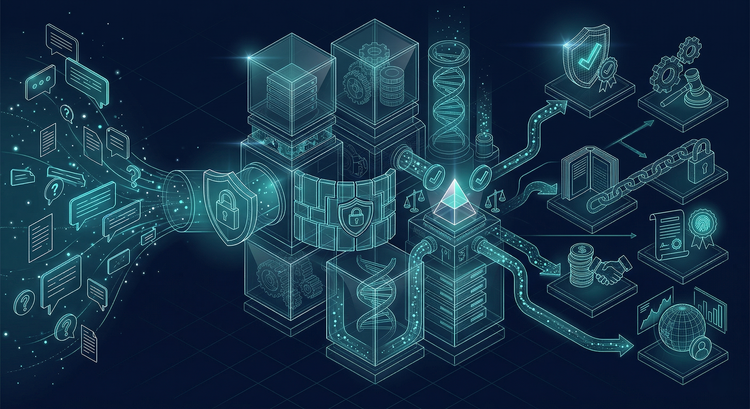
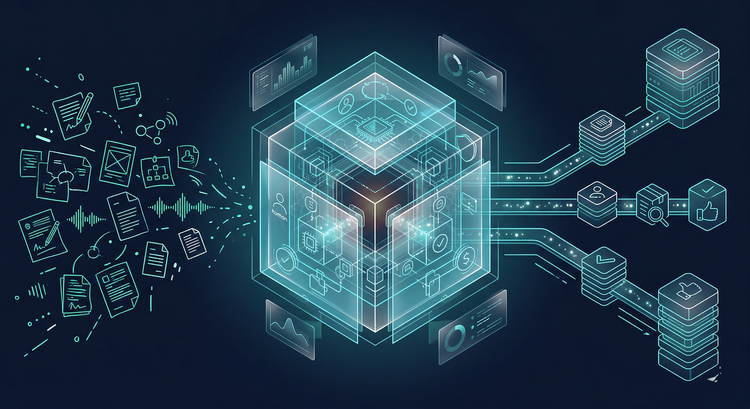
Qi is an intelligent cooperating system. We shifted the focus from "generative speed" to "shared state."
In a typical workflow, an AI generates an output, and a human has to judge it. In Qi, agents cooperate over a persistent, shared representation of the work. They don't just "talk"; they update the state of the project.
This changes the physics in three ways:
- Coherence over Speed: Instead of ten agents sprinting in different directions, they are constrained by shared intent. They can’t "hallucinate" progress; they have to prove state transitions.
- The "Check" is Baked In: We don't wait for the end to see if the system worked. Verification is part of the flow. If an agent’s output doesn't match the required schema of the shared state, it is rejected immediately—before it becomes expensive rework.
- Signal, Not Noise: We treat intermediate steps as shared signals, not final products. This stops the "throw it over the wall" mentality that creates the rework loops Workday identified.
The Construction Site
Think of a construction site. The current AI approach is like giving every bricklayer a machine gun that fires bricks. Sure, they are laying bricks faster than ever. But without a blueprint and a foreman, you don't get a building. You get a pile of rubble that takes twice as long to clean up.
Qi is the blueprint and the foreman. It ensures that the speed of the bricklayer actually contributes to the integrity of the wall.
Closing the Gap
The productivity paradox isn't going to disappear when GPT-6 comes out. A smarter model won't fix a broken process.
The only way to turn "subjective speed" into "objective outcome" is to restructure how work is represented. We have to move from isolated acts of generation to sustained loops of cooperation.
Questions for your team:
- Where are you seeing the "Rework Tax" most clearly? Is it in code review? Content approval? Data cleaning?
- Are you measuring the speed of the task, or the speed of the outcome?
- What would happen if you stopped trying to make the AI faster, and started trying to make the context clearer?