In the startup world, we’re told a specific story about success. It’s supposed to be a lightning strike of genius, a hockey-stick growth chart, and a swift exit.
Looking back at a decade of building IXO, that story feels foreign to me.
I recently watched a clip of Jensen Huang discussing NVIDIA. He didn't talk about "passion" or "flow." He framed the work as suffering. He described the job not as hours logged, but as the ability to hold a problem in your head—unresolved, complex, painful—until it cracks.
That resonated (Though, to be clear, I’m no Jensen).
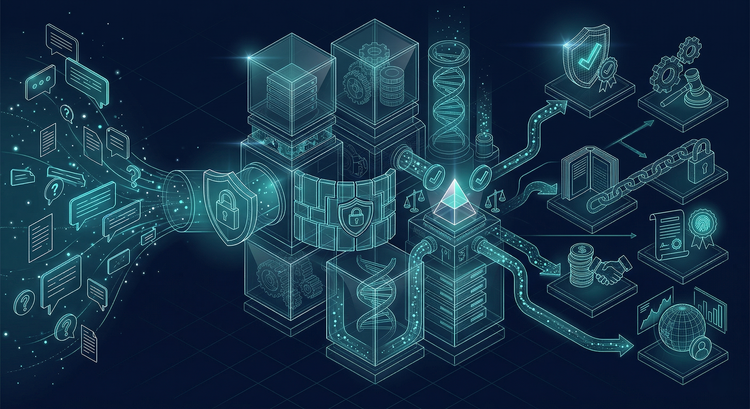
Building IXO, trying to engineer a digital immune system for the real world hasn't been a series of sprints. It’s been a state of being. It is the distinct burden and privilege of carrying a problem that refuses to be solved easily.
 Dr Shaun Conway
Read: "You can think of it as a digital immune system for getting important work done in the real world:..."
The Fallacy of Delegation
There is a standard piece of management advice: Hire smart people and get out of the way.
That works for execution. It fails for understanding.
There is a dangerous fallacy that you can delegate the "why" and the "how" while simply managing the "who." At IXO, I’ve often resisted the urge to offload strategic thinking too early. Whether we were defining claim integrity, architecting governance, or exploring intelligent cooperation mechanisms, I felt a responsibility to maintain cognitive continuity.
If I had handed off the core architectural decisions in Year 3, we would have moved faster. But we would have lost coherence. If we hadn’t sometimes failed, learned and restarted, we would not be here today.
By staying engaged in the unconstrained problems—the ones that actually hurt your brain to think about—I’ve tried to ensure that our protocols aren't just a patchwork of features. They had to become a unified language.
Sometimes this looked like micromanagement. Some people have described me as stubbornly tenacious. I think of this as risk management. You cannot make good judgments under conditions of uncertainty if you don't deeply understand the context and the machinery yourself, with a drive to get it more right than wrong, and an unwavering vision of what success will look like.
Pressure is a Design Constraint
We built through the skepticism. We built through "crypto winters" where the noise of speculation drowned out the signal of utility.
It’s easy to view that pressure as a misfortune. I see it as a filter.
External doubt and structural complexity acted as a crucible. We couldn't afford to be sloppy because the environment didn't allow for it. When you don't have infinite capital or hype to hide behind, you are forced to be a high-signal thinker. The pressure stripped away the weak ideas and left only what was robust enough to survive.
This is just evolution. Your ideas have to be fit to survive.
The Moat of Duration
In a culture obsessed with speed, endurance is a contrarian bet. Watching the current vibe coding craze this seems even more pertinent now.
Over the years there were moments we could have pivoted. We could have optimised for intensity spikes—cashing in on the ICO wave, chasing the NFT wave, or hyping the AI wave, just to get a temporary valuation bump. Instead, we chose the slower, heavier path of steady contextual accumulation.
This is the hidden value of the last decade. Our "productivity" wasn’t defined by flashy launches, but by the relentless sedimentation of learning, tooling, and protocol maturity.
Speed can be copied.
Endurance creates a moat that competitors cannot replicate.
The pattern recognition we possess today regarding decentralisation and verification wasn't bought. It was hard-earned through experience. We understand the contours of this problem space simply because we stayed when others drifted away.
The Trade-off
I want to be clear about the cost.
When you refuse to treat work as a task list and instead treat it as a continuous cognitive state, you sacrifice peace. Unresolved problems occupy your mental space at dinner. They wake you up at 3 AM.
I have paid this cost in mental load and in the long, quiet wait for validation. But I view this cost as the currency that underwrites IXO’s strategic depth.
The culture of IXO—our resilience, our focus on craft—wasn't shaped by a slide deck. It was shaped by the example of effort. Contributors saw that we were willing to carry this weight, year after year. That became the signal of belonging. It is the commitment that binds and continues to motivate our wonderful team.
The Long Game
Today, IXO stands on a foundation that is > ten years deep.
We prioritised the hardest foundations first—protocol primitives, shared state, data integrity, governance—before the ancillary features. We chose the pain of clarity over the comfort of ambiguity. And we grounded it all in the real world, testing against low-resource environments where things actually break.
As we deploy Qi for intelligent cooperation with IXO as infrastructure for human thriving, I am convinced that endurance is our core unit of value.
We didn't just survive the last decade. We used it to build the only thing that matters: something that works.
A Question for fellow Founders and Builders:
Where are you confusing speed with progress? And what is the one problem you are avoiding because it hurts to think about?