The AI narrative is moving from "chatting with a bot" to "managing a team." With OpenAI Frontier and Anthropic’s Agent Teams the leading model providers are now pitching "Agent Teams" as AI coworkers that onboard, take direction, and coordinate in parallel.
On the surface, this looks like progress. It feels like we’re finally getting the "digital employees" we were promised. But if you’ve ever managed a human team—or shipped a distributed system—you know that adding more actors doesn't just increase throughput. It increases entropy (which is a polite way of saying this generally results in a sh*tshow).
 Dr Shaun Conway
Read about the "HR Department" we need to build for the Agent economy.
The current industry focus is on "HR for bots"—identity, permissions, and boundaries. That’s fine. But you don’t manage a system by giving the components names and job descriptions. In business, you manage work by defining what "done" means and how this gets settled.
Management Without a Contract
The "Frontier" approach treats agents like people: give them a login, a long memory, and a set of instructions.
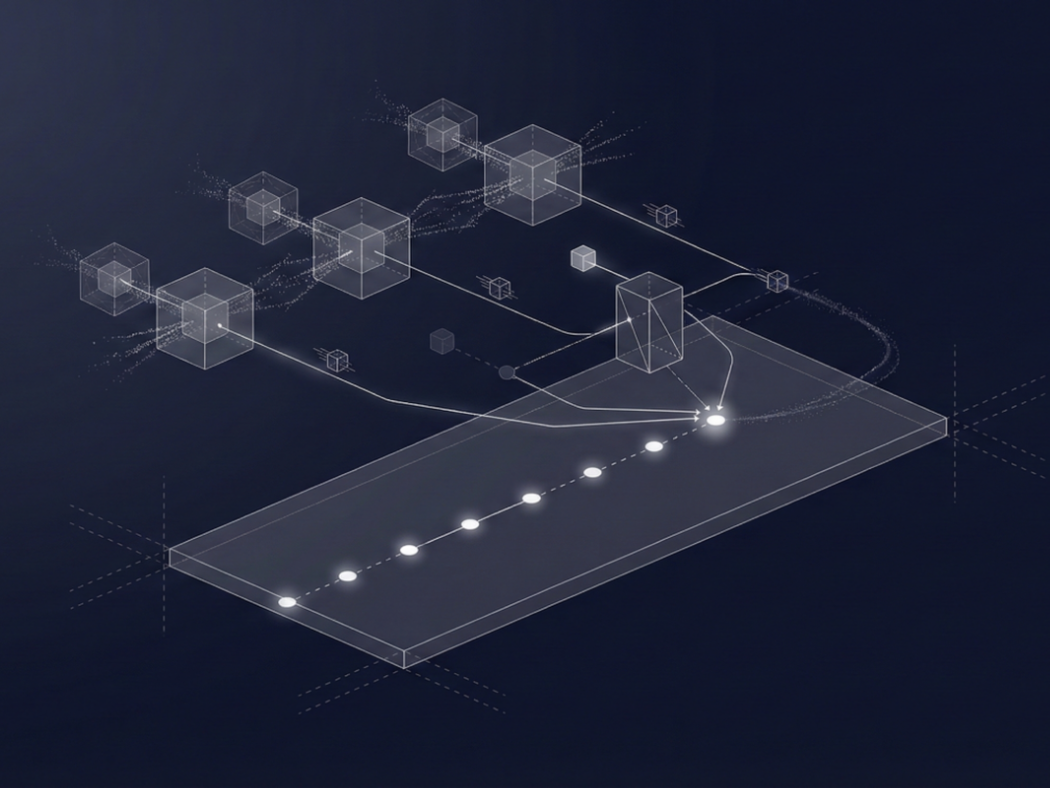
But when you move from a single chatbot to five agents running in parallel, you don't just have a productivity boost. You have a concurrency problem. If three agents are reading your codebase, two are updating your docs, and one is committing a fix, what is the authoritative state of your project?
If you’re relying on "shared context" to keep them aligned, you’re betting on memory. And memory drifts. In a large context window, "longer memory" doesn't mean "better coordination." It just means the agent can remember its mistakes for longer.
In the physical world, work isn't finished just because someone said it was. It’s settled when the contract is signed, the invoice is paid, or the audit passes. There is a closure of the loop.
Most agentic models today are missing that closure. We have:
- Orchestration: Assigning the task.
- Execution: Running the tool.
- Observation: Watching the logs.
But where is the Settlement? Without a shared state machine, every agent is just operating on its own local, slightly hallucinated copy of reality.
Moving From "Chat" to "State"
The reason we’re skeptical of "chat" as a work interface is that chat is a terrible container for accountability. It’s a stream of consciousness, not a record of truth.
To build systems that actually work in production, we have to stop treating agent output as "the answer" and start treating it as a Claim.
- The Claim: An agent performs a task and submits a statement: "I have updated the vendor list based on the new compliance guidelines."
- The Evidence: That claim must be attached to an immutable proof—a link to a diff, a cryptographic log, or a specific API response.
- The Settlement: The claim is evaluated against a rubric (by a human or a specialised validator). Only then does the "State" of the system update.
This is the difference between an AI coworker who tells you they did the work and a system that proves the work is done. One is vibes; the other is a protocol.
The Hidden Cost of Agency
There is a massive trade-off here that isn't being talked about: Coherence vs. Execution.
Agents make execution nearly free. You can generate a thousand PRs for the cost of a cup of coffee. But agents don't make coherence cheap. They make it much more expensive. The more agents you have running, the harder it is to maintain a single version of the truth.
If you adopt "Agent Management" today without a settlement layer, you are buying speed at the cost of auditability. You are forking your reality.
A Playbook for the Skeptical
If your team is looking at "Agent Teams" this quarter, stop asking which agents to hire. Start asking how you're going to govern the transitions.
- Identity is a Mandate: Don't just give an agent a login. Give it a scoped mandate. What is the one specific thing it is authorised to change?
- Kill the Copy-Paste: If your agents are moving data between windows, you’ve already lost provenance. Move the work into a shared environment where every change is attributable and signed.
- Build the Decision Trace: Never let an agentic action be irreversible without a settlement step. You need to be able to reconstruct why a decision was made six months after the agent's context window has been cleared.
The "Frontier" approach tries to make agents act more like people—messy, forgetful, and hard to audit. Our goal should be the opposite: make the work act more like a protocol.
In the agent economy, the winner won't be the one with the most bots. It’ll be the one who can actually prove what their bots did.
Three questions for your engineering team this week:
- If we run ten agents in parallel on this project, how do we reconcile conflicting outputs without a human reading 5,000 lines of logs?
- Do we have a "Settlement Layer" for our automated tasks, or are we just hoping the "Shared Context" stays in sync?
- Are we building "HR for Bots," or are we building a system that can survive a forensic audit?