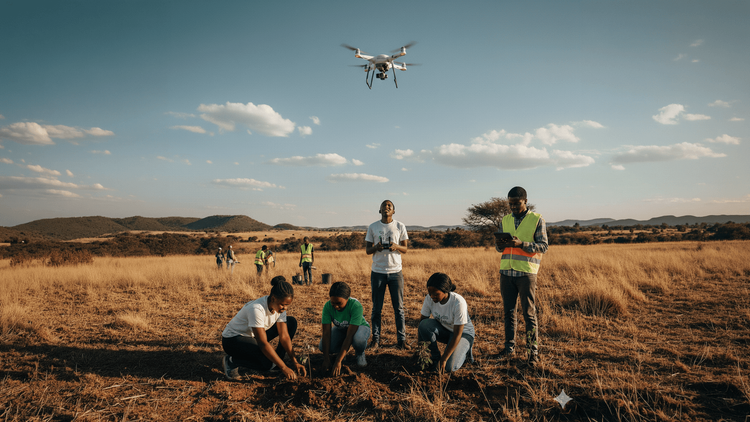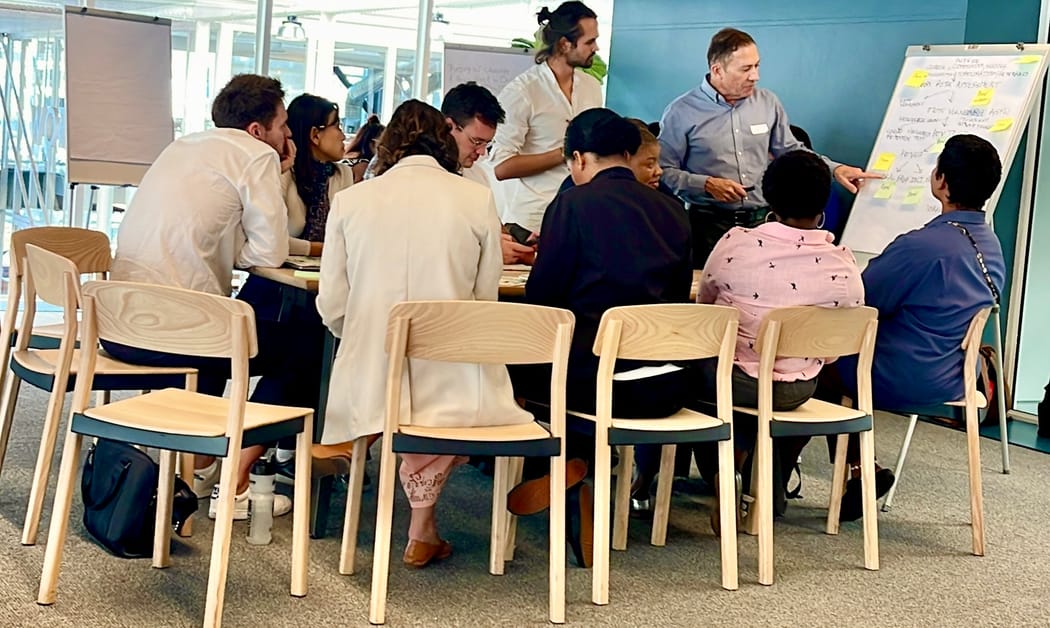
On 24 March 2026, the Yoma Impacts Round-table in Cape Town brought together leaders from government, UNICEF, IXO, civil society, and youth impact-oriented organisations to explore a shared challenge: how to make youth-led work in the green economy more visible, verifiable, and fundable. The conversation moved well beyond platform demonstration. It focused on how Africa can build the institutional, technical, and financial architecture needed to turn fragmented youth activity into trusted outcomes that can be supported at scale.
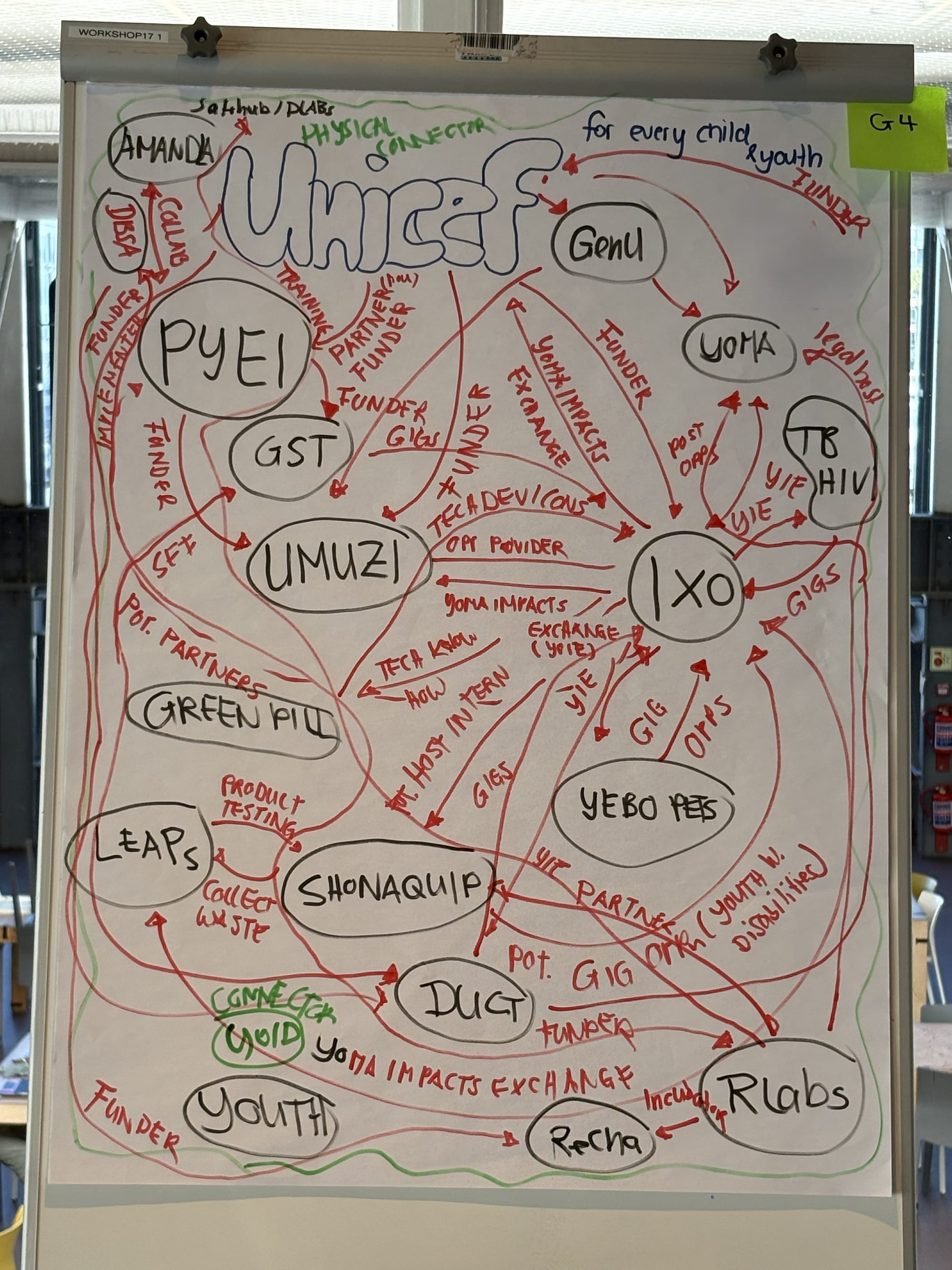
From a jobs crisis to an outcomes opportunity
One of the strongest contributions came from South Africa’s Presidential Youth Employment Intervention (PYEI), which framed the country’s challenge not simply as youth unemployment, but as a deeper “missing jobs” crisis compounded by information asymmetry. The message was clear: for years, large sums have been spent on skilling and youth programmes without sufficient visibility into whether they are truly resulting in sustainable employment.
In response, the Presidency has increasingly shifted toward outcomes-based approaches such as the Jobs Boost Youth Employment Outcomes Fund, which rewards demonstrated job creation rather than inputs alone. This was presented as a major signal that public systems are becoming more open to outcomes-based finance, especially in emerging sectors relevant to the green economy.
The round-table therefore positioned the green economy not just as a thematic area for youth engagement, but as a frontier that still requires better data, better coordination, and better mechanisms for trust. Participants heard that the South African government, through the Office of the Presidency, is actively looking for practical use cases that can show how AI and digital systems can improve responsiveness rather than create further disruption. Noluthando Mthonti-Mlambo, Growth Sectors Lead at the PYEI, spoke about how AI could be either an unresolved risk or an emergent opportunity for youth, which transitioned into the next segment.
The functions of the Impact Exchange
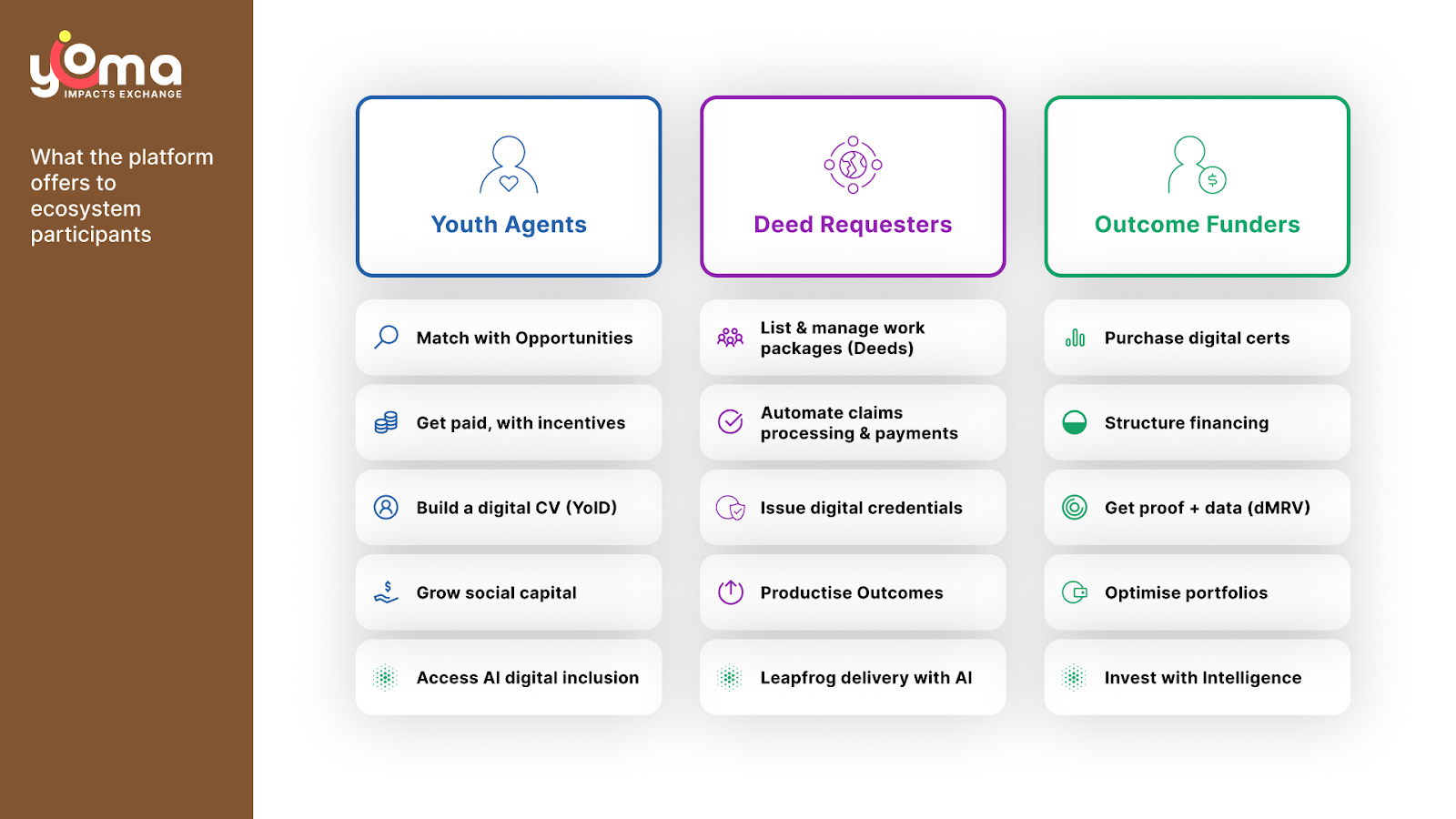
The Yoma Impacts Exchange is not just another marketplace. Shawn Alimohammadi, the project lead, described this as an enabling engine for five core functions: coordination, financing, governance, verification, and intelligence/learning. The platform is intended to connect capital, talent, and deeds—which are digitally-enabled executable packages of work; make it easier to fund both work and outcomes; govern workflows transparently; prove that activities actually happened; generate digital outcomes certificates and credits as fundable and tradable assets; and build continuous learning loops from the resulting data.
This broader framing is important. The day was not only about matching youth to opportunities. It focused on how we are digital public goods infrastructure that can support a new class of impact products and more adaptive forms of programme management that make effective use of cutting-edge digital capabilities and intelligence.
From “Gigs” to “Deeds”
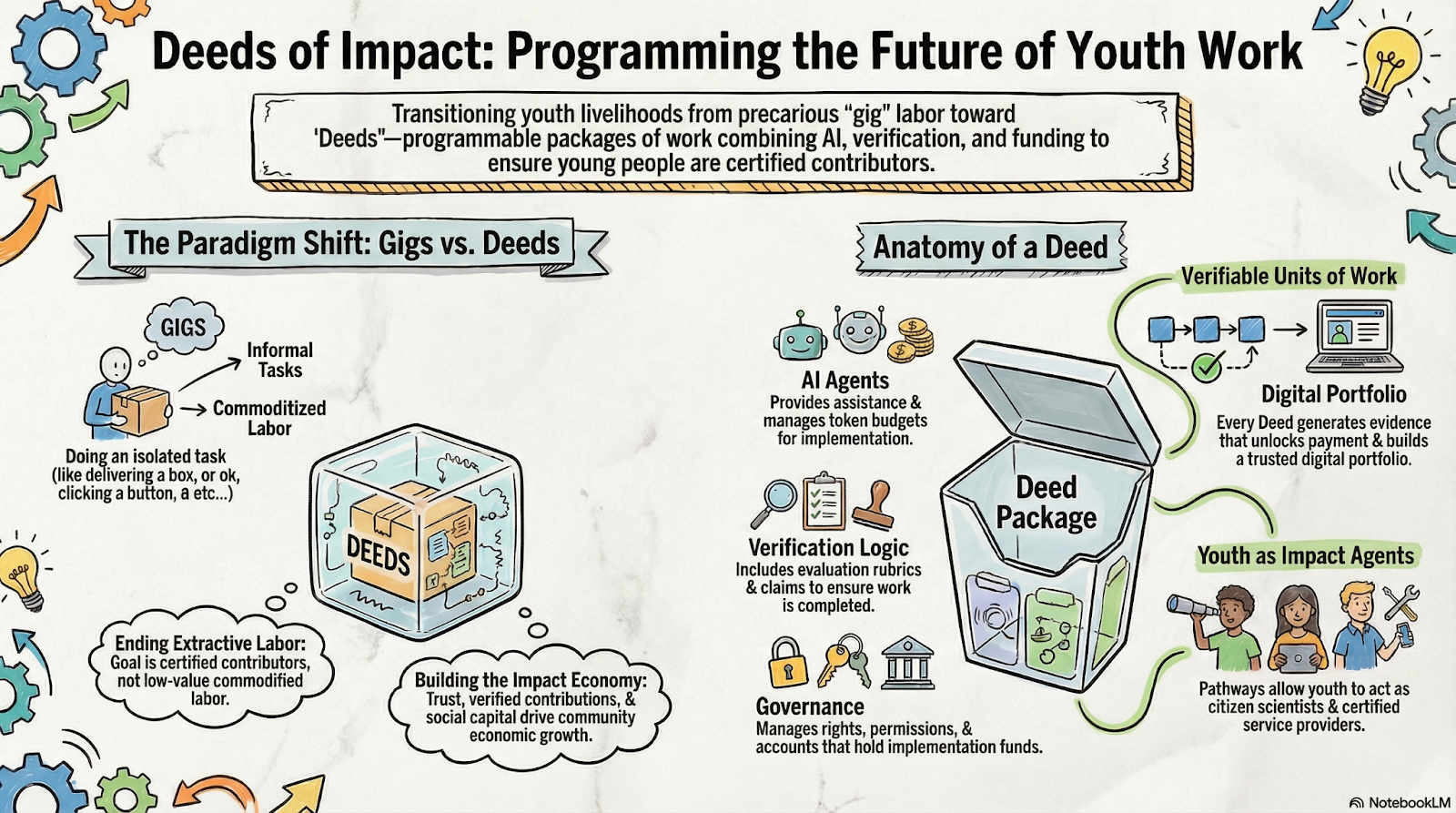
A central conceptual shift in the day was the move away from talking about youth opportunities merely as “gigs.” Instead, IXO introduced the concept of Deeds as programmable packages of work that combine a budget, instructions, verification logic, and AI assistance—including a token budget. In this framing, a young person is not simply completing an informal task; they are performing a verifiable unit of work that can generate evidence, unlock payment, and contribute to a growing portfolio of trusted digital credentials.
Deeds package information resources such as instructions, claims, evaluation rubrics, service integrations, governance mechanisms, rights and permissions, AI agents and AI token budgets, group messaging, and accounts that hold funds for implementation.
This matters because the workshop repeatedly returned to the idea that the future of youth livelihoods should not be extractive. The aim is not to build a system where young people are reduced to low-value commodified labour at the edge of automated systems. The aim is to create pathways through which young people can be enabled and empowered to work in the green economy as certified contributors, citizen scientists, service providers, and impact agents whose work and knowledge retain economic and social value within their communities. In this sense, the round-table promoted the growth of a broader green impact economy, in which trust, verified contribution, and social capital drive economic value.
The Yoma Venture Cooperative as a coordination Layer
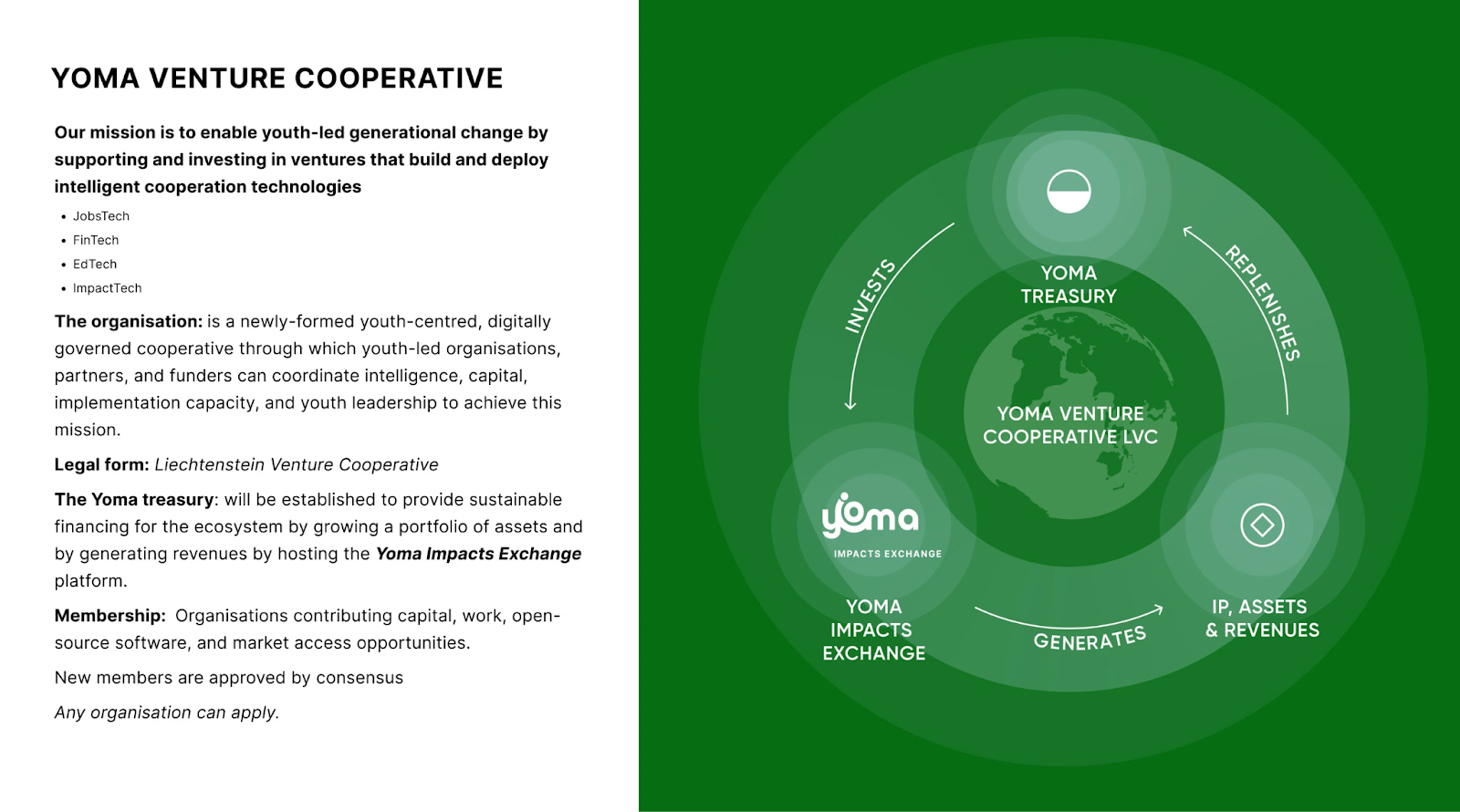
Yoma’s Venture Cooperative in Liechtenstein is a major institutional milestone. This organisational model means that UNICEF, as promoter, and IXO, as lead implementer, do not own Yoma or the Impacts Exchange as a centrally controlled product. Instead, the cooperative provides a shared institutional layer for long-term stewardship, enabling contribution-based participation from organisations that bring capital, implementation capacity, technical infrastructure, market access, or intellectual contributions.
It is designed to make the ecosystem more durable, more transparent, and more aligned with the values of shared ownership and programmable governance. In practical terms, it creates a mechanism through which multiple actors can cooperatively build and cooperatively benefit from the digital infrastructures and innovations that will drive a youth-led impacts economy globally. The mission of this cooperative is to use sovereign digital technologies and AI to create livelihoods for young people and bring about generational positive change in the world.
Design Partner Programmes and Solutions Engineers for scaling capacity
IXO and Yoma announced the launch of a third cohort of for a Design Partner Programme with a stronger emphasis on immediate onboarding and practical use cases. Partners will not simply observe the platform; they will use it from the outset to shape their own digital measurement, reporting, verification (dMRV) and finacing workflows, align reporting requirements with what funders expect, and configure the deeds, claims, and certification that can attract investment and outcomes-based financing. This shift requires more hands-on support inside partner contexts, which is why the Solutions Engineers Programme is critical to scaling delivery capacity.
The programme will train and forward-deploy a network of Solutions Engineers to work within organisations and support digital transformation. The focus is on practical systems engineering rather than traditional technical training. Solutioneers will learn to diagnose organisational needs and build functional systems for measurement, reporting, verification, and financing. By embedding this capacity within partner organisations, the programme helps ensure that the impact economy scales from the inside out.
From Theory of Change to real-time dMRV
A central theme of the workshop was the need to move beyond static Theories of Change and post-hoc reporting toward live digital systems for digital Measurement, Reporting, and Verification (dMRV). Participants reflected on how most programmes still separate delivery from verification: work happens first, evidence is collected later, and financing decisions are often made at a distance from what actually took place. The discussion therefore focused on redesigning programmes so that evidence generation is embedded from the outset.
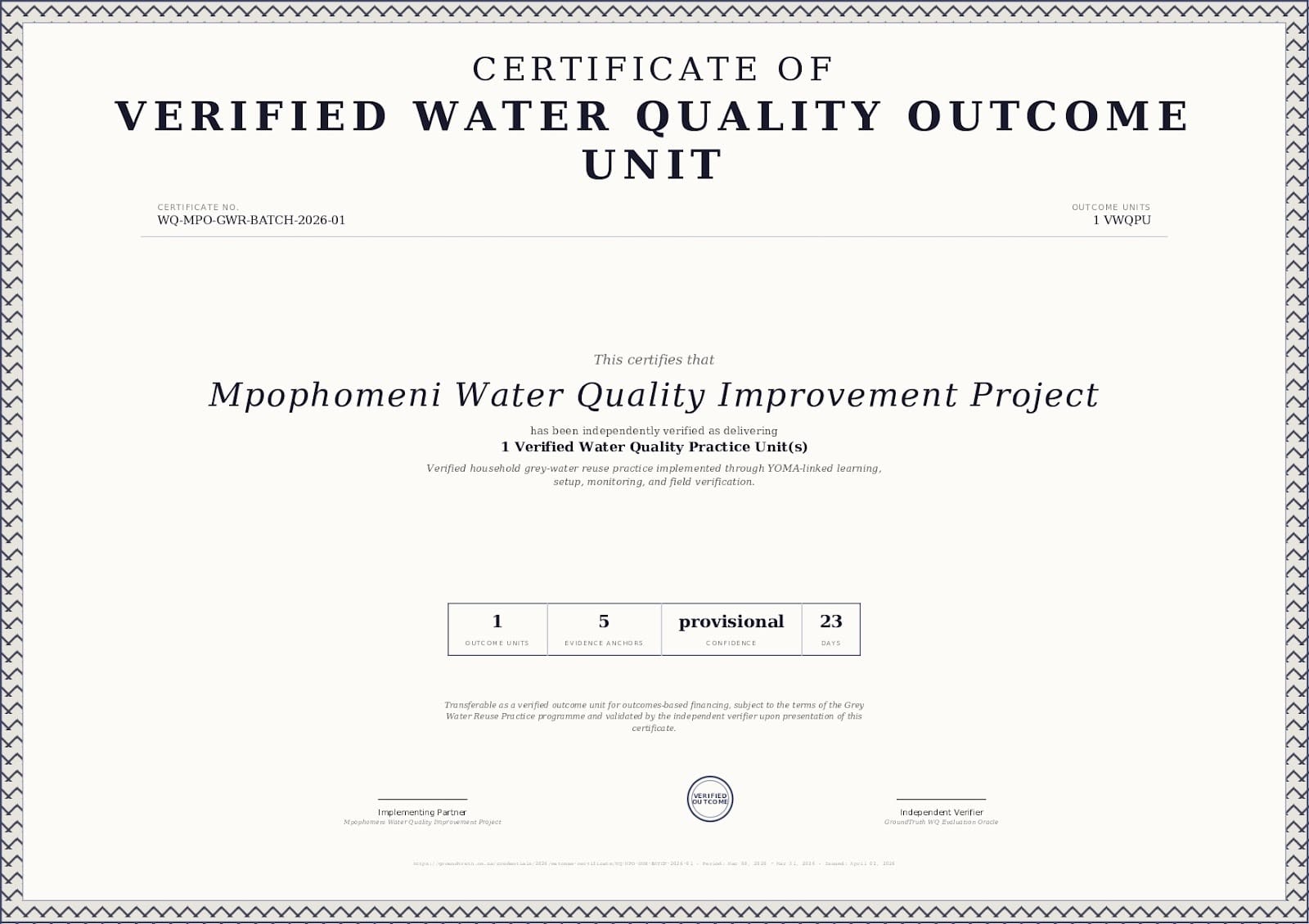
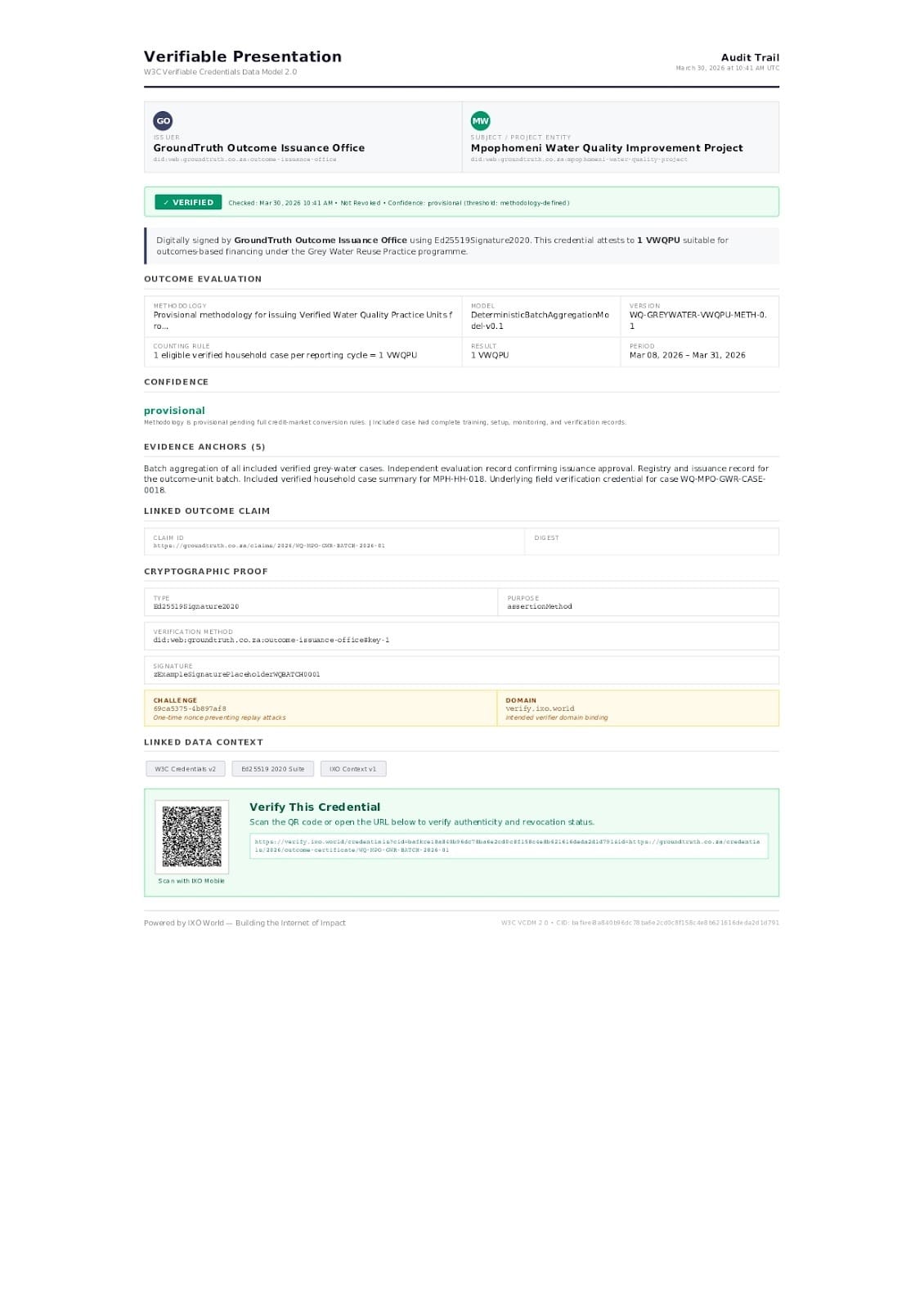
This was made tangible through a live demonstration showing how workshop breakout group transcripts, theories of change, and reference materials can be fed into an AI agent to rapidly produce prototypes of digital claims and credentials, without the need for specialised technical skills. The demonstration showed how data schemas and evaluation logic can be structured in real time, and how verified activities flow into digital credential graphs, to produce Impact Certificates. These certificates are the artefacts that hold the programme logic together by defining who is involved, what data is required, and how evidence moves through the system.
This was a powerful demonstration of how AI can be used as a system design tool, using some paper-based source materials and the transcripts that had been generated during the workshop breakout group activity, turning these into a digital certificate format and a human-readable narrative for reporting and communication. The discussion also acknowledged the environmental cost of AI, underscoring the importance of using the right model for the right task and sourcing infrastructure responsibly.
The funder-to-youth marketplace
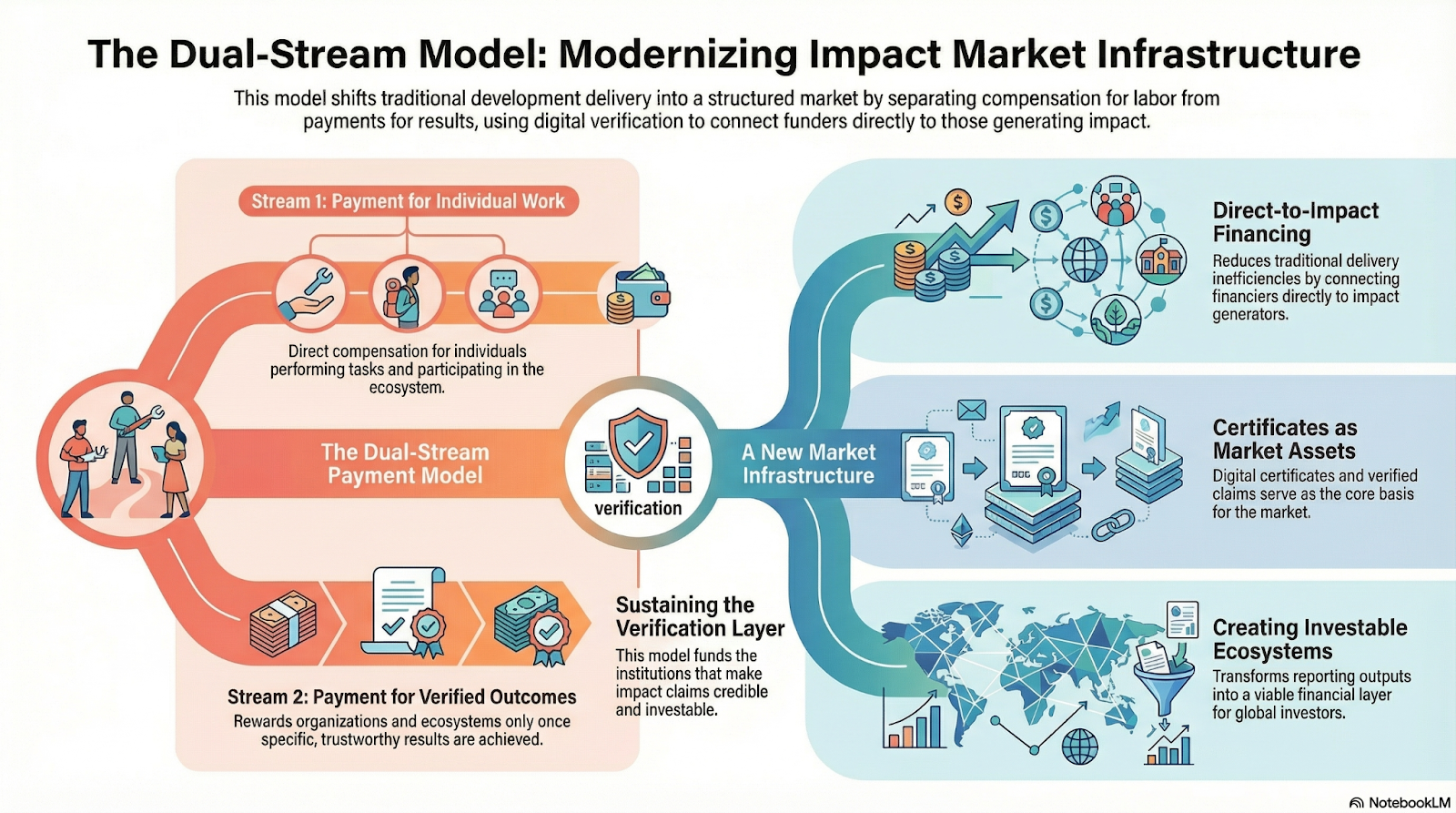
One of the clearest economic ideas to emerge from the day was the distinction between two payment streams. The first is payment to individuals for performing work. The second is payment to organisations or ecosystems for verified outcomes achieved. This dual-payment model is important because it allows youth to be compensated for participation while also creating a viable financial layer for the systems, institutions, and verifications that make outcomes trustworthy.
Participants were encouraged to think of the Yoma Impacts Exchange as a new kind of marketplace platform that reduces the inefficiencies of traditional development funding and delivery by creating a more direct relationship between the funders of impact and the producers of impact. Digital certificates based on verifiable credentials are data assets that can be invested in, purchased, and traded.
What the future of youth impacts looks like
By the end of the day, the round-table had clarified several things.
First, the green economy cannot scale youth opportunity without stronger systems for trust, verification, and coordination. Second, outcomes-based finance is no longer a fringe idea; it is increasingly relevant to public policy, especially where governments are seeking better value and clearer results. Third, digital public infrastructure for impact must be paired with institutional forms that support shared ownership and continuity. Finally, AI’s most powerful role may be in helping organisations move faster from ideas and theories of change into usable, auditable systems.
The Yoma Impacts Round-table surfaced a broader proposition: that youth-led work in Africa’s green economy can be measured differently, governed differently, and financed differently to support youth-led generational change. If that proposition holds, then verified impact may not just become a reporting requirement, but a new economic asset class that can help grow the impact economy.
View the presentation: "Yoma Impacts Exchange: Engineering and Outcomes-driven Green Economy"
Download the Yoma Workshop Impact Credential Digital Workbench Recording and resource files: "Creating Outcomes Certificates from a ToC" - After downloading, start by viewing the video recording.
For information, contact: